
If you’re dealing with pain at the front of your knee during or after activity, you might be experiencing jumper’s knee, also known as patellar tendinitis.
At our clinic, we’ve been seeing an increase in this type of injury—especially in active adults and pickleball players here in Burlington. The good news? With the right approach, it’s very treatable.
If you’re looking for a chiropractor in Burlington who understands sports injuries and movement-based rehab, this guide will walk you through exactly what’s going on—and what to do about it.
What Is Jumper’s Knee?
Jumper’s knee (patellar tendinitis) is irritation and inflammation of the patellar tendon, which connects your kneecap (patella) to your shin bone.
Here’s how it works:
- Your quadriceps muscles (front of the thigh) attach to your kneecap
- From there, the patellar tendon continues down to your shin
- When this tendon is overloaded, it becomes painful and irritated
Common Symptoms
- Pain just below the kneecap
- Discomfort during or after activity
- Stiffness when starting movement
- Tenderness at the front of the knee
This is especially common in:
- Pickleball players
- Basketball and volleyball athletes
- Runners
- Anyone doing frequent stop-and-go movements
Why It Happens
Jumper’s knee is typically caused by repetitive strain and overuse.
In sports like pickleball, your knee is constantly dealing with:
- Rapid acceleration and deceleration
- Quick direction changes
- Repeated loading through the tendon
Over time, if the tendon’s capacity doesn’t match the demand, pain develops.
Jumper’s Knee Treatment in Burlington: What Actually Works
The biggest mistake people make?
Only resting and icing.
While that may temporarily reduce pain, it doesn’t fix the underlying issue—your tendon’s ability to handle load.
Here’s what an effective treatment plan should include:
1. Relative Rest (Not Complete Rest)
You don’t need to stop activity completely.
Instead:
- Reduce frequency (e.g., 5 days/week → 3 days/week)
- Avoid pushing through sharp pain
This keeps you active without continually irritating the tendon.
2. Ice for Acute Pain
If symptoms are new or flared up:
- Apply ice to the front of the knee
- 10–15 minutes at a time
- Especially after activity
This helps calm inflammation early on.
3. Quadriceps Stretching
Tight quads increase tension on the patellar tendon.
Simple stretch:
- Stand and pull your heel toward your glutes
- Feel the stretch in the front of your thigh
- Hold for 20–30 seconds
- Repeat daily
4. Isometric Strengthening (Key Step)
This is where real recovery begins.
One of the best starting exercises is the wall sit:
- Hold for 20–45 seconds
- Stay in a pain-free range
- Repeat 3–4 times
- Rest 1–2 minutes between sets
- Perform once or twice daily
This helps:
- Reduce pain
- Improve tendon capacity
- Prepare you for more advanced rehab
5. Gradual Return to Activity
As symptoms improve:
- Slowly increase intensity
- Avoid jumping straight back to full activity
This is where many people relapse—progression matters.
6. Shockwave Therapy
For stubborn cases, shockwave therapy can be highly effective.
It works by:
- Increasing blood flow
- Stimulating healing
- Reducing chronic tendon pain
This is a common treatment we use in our clinic for faster recovery.
What About Teens? (Osgood-Schlatter Disease)
In adolescents, a similar condition called Osgood-Schlatter disease can occur.
This involves irritation at the growth plate where the tendon attaches to the shin.
Treatment is very similar:
- Reduce load
- Stretch
- Strengthen
- Gradually return to sport
How Long Does It Take to Heal?
With proper treatment, most people improve significantly within:
3 to 6 weeks
The key is:
- Addressing load tolerance
- Not just masking symptoms
When to See a Chiropractor in Burlington
If your knee pain:
- Isn’t improving
- Keeps coming back
- Is limiting your activity
…it’s time to get it properly assessed.
At our clinic, we focus on:
- Identifying movement patterns causing overload
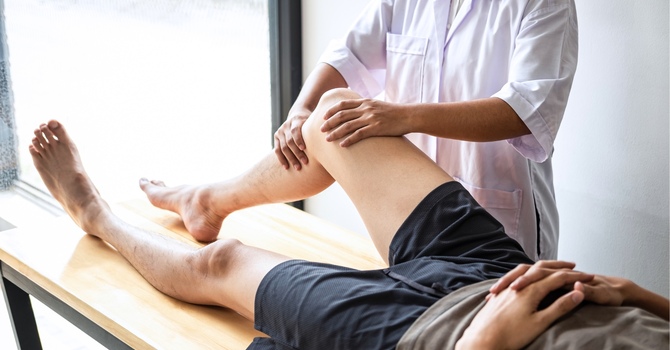
- Hands-on treatment to reduce pain
- Structured rehab to rebuild tendon strength
- Sport-specific return-to-play planning
Final Thoughts
Jumper’s knee is frustrating—but very manageable with the right approach.
The goal isn’t just to get you out of pain.
It’s to make sure your knee can handle the demands of your sport long-term.
If you’re looking for jumper’s knee treatment in Burlington or want to work with a chiropractor in Burlington who understands athletes and active adults, we’re here to help.
Need help with knee pain?
Book an assessment and let’s get you back to playing—stronger than before.

.png)
